
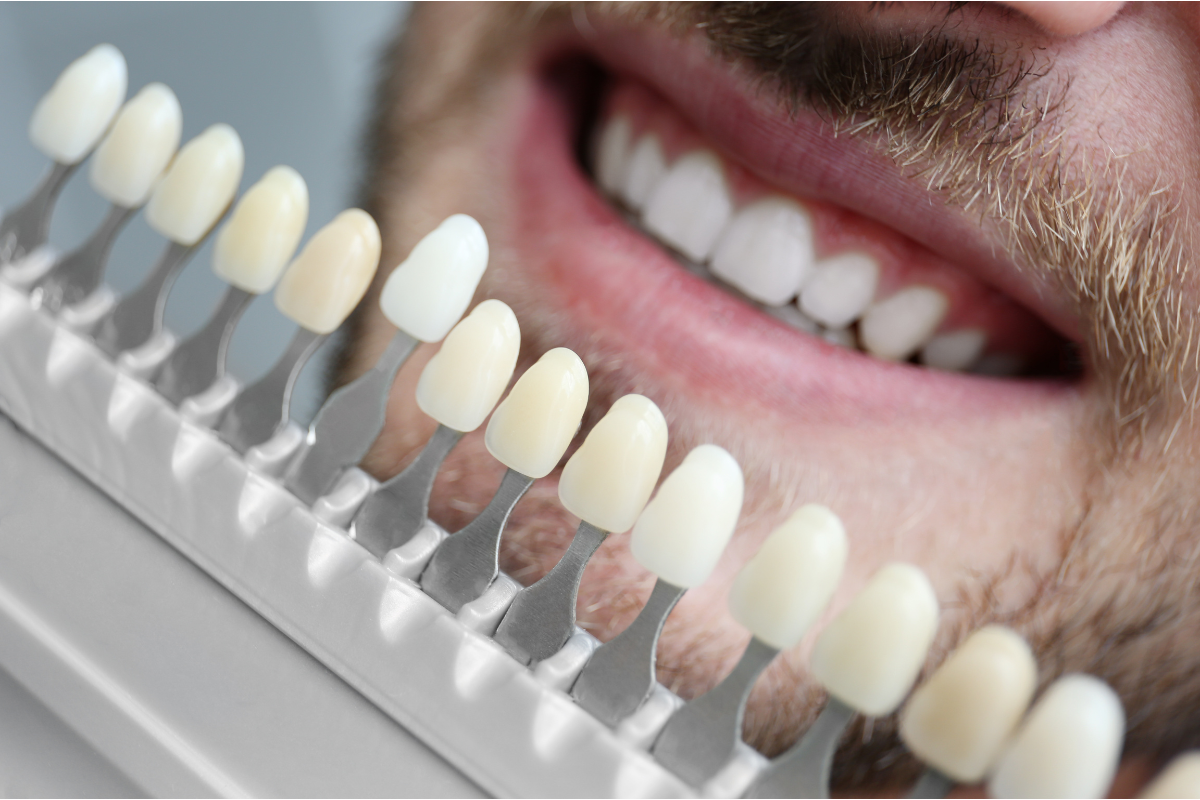
Can You Whiten Crowns, Veneers, or Fillings?
Teeth whitening lightens the visible enamel and dentin of natural teeth, but many patients have existing dental work such as crowns, veneers, or fillings and want to know whether whitening treatments will lighten those as well. The short answer is no. Understanding why restorative materials respond differently than natural teeth, and what that means for anyone considering teeth whitening in Abu Dhabi with existing dental work, makes it easier to plan treatment without an unexpected mismatch in color.
Why Teeth Whitening Works Differently on Natural Enamel
Whitening treatments use bleaching agents, typically hydrogen peroxide or carbamide peroxide, that penetrate the microscopic pores in natural enamel and the dentin beneath it. These agents break down the compounds responsible for staining, which lightens the visible color of the tooth over the course of treatment.
Restorative materials such as porcelain, ceramic, zirconia, composite resin, and metal alloys do not have this same porous structure. Their color is set during manufacturing or placement, and bleaching agents have little to no effect on the surface once it has cured or been fired. This is the main reason existing dental work does not lighten alongside natural teeth during a whitening treatment.
Can You Whiten Crowns?
A dental crown is fabricated to match the shade of the surrounding teeth at the time it is made, whether from porcelain, ceramic, zirconia, or a metal alloy with a porcelain overlay. Because the shade is fixed during fabrication, whitening treatments will not lighten a crown. If the natural teeth around a crown are whitened afterward, the crown can end up noticeably darker than the surrounding teeth by comparison, even though its actual color has not changed.
Can You Whiten Veneers?
Veneers work the same way. Whether made from porcelain or composite resin, a veneer’s shade is determined before it is bonded to the tooth and does not respond to bleaching agents afterward. A veneer that matched perfectly at the time of placement can appear duller once the surrounding natural teeth have been whitened.
Can You Whiten Fillings?
Tooth-colored composite fillings do not whiten either, although they can gradually pick up surface staining over time in a way that porcelain restorations typically do not. Metal fillings, such as amalgam, are unaffected by whitening treatments in every respect. As with crowns and veneers, whitening the natural teeth around a filling can make it more visible if the color difference becomes noticeable.
What Happens When Natural Teeth Are Whitened Around Existing Restorations
- The restoration keeps its original shade. Whitening gel does not damage or discolor crowns, veneers, or fillings, but it also will not lighten them.
- A shade mismatch can develop. As natural teeth lighten, any visible restoration nearby may start to stand out more than it did before treatment.
- Sensitivity is possible in natural teeth. This is unrelated to the restoration itself, but it is worth discussing with a dentist beforehand, especially for teeth with existing dental work close to the gumline.
- Restorations located out of the smile line are less noticeable. A crown on a back molar, for example, is less likely to create a visible mismatch than a veneer on a front tooth.
Planning Whitening Around Existing Dental Work
Patients who know they will eventually need a crown, veneer, or filling on a visible tooth are often better served by completing whitening treatment first, so the new restoration can be color-matched to the whitened shade rather than the original one. For patients who already have visible restorations and want a brighter smile, replacing the restoration to match a new shade is sometimes the more realistic option, since whitening alone will not align the two. A dentist at a practice such as Al Bahri Dental & Orthodontic Center can help plan the order of treatments to avoid this outcome.
The Case for Professional Teeth Whitening in Abu Dhabi
A dentist evaluating a patient for teeth whitening in Abu Dhabi can identify which teeth carry crowns, veneers, or fillings before treatment starts, and can set realistic expectations about how the final result will look next to existing dental work. This kind of planning is harder to replicate with over-the-counter whitening kits, which are not able to account for restorations already in the mouth. At Al Bahri Dental & Orthodontic Center, this evaluation is a standard part of any whitening consultation, particularly for patients with visible dental work on their front teeth.
Conclusion
Crowns, veneers, and fillings do not respond to whitening treatments the way natural enamel does, since their shade is fixed at the time they are made or placed. This is worth knowing before starting a whitening plan, since the more useful question is often not whether a restoration can be lightened, but how to time treatment so the final result looks even. Anyone considering teeth whitening in Abu Dhabi with existing crowns, veneers, or fillings can get a clearer picture of what to expect with a consultation at Al Bahri Dental & Orthodontic Center. Book your appointment today. Visit albahridental.com, call +971 2 575 1856 (Abu Dhabi) or +971 3 764 3273 (Al Ain), or WhatsApp us at +971 56 343 1856.
FAQs
Will teeth whitening damage my crowns, veneers, or fillings?
No. Whitening treatments do not damage or discolor these materials, but they also will not lighten them, so no harm comes to existing restorations from the process itself.
How can I avoid a mismatch between my natural teeth and a crown after whitening?
Completing whitening treatment before a crown or veneer is placed allows the restoration to be shade-matched to the new, whitened color. If the restoration already exists, replacing it may be the only way to bring the shade back into alignment.
Do composite fillings stain more than porcelain restorations?
Yes, composite fillings can pick up surface staining gradually over time, more so than porcelain or ceramic restorations, though this is a separate process from teeth whitening itself.
Is it possible to whiten just the natural teeth around a crown or veneer?
Yes. Whitening only affects natural enamel and dentin, so it is possible to whiten the surrounding teeth without any effect on nearby restorations. This is exactly why a shade mismatch can develop if the difference is not planned for in advance.
Should I whiten my teeth before or after getting a new crown or veneer?
In most cases, before. Whitening the natural teeth first allows a new restoration to be matched to the final shade rather than a shade that may change afterward.

