

Pediatric Dentistry

Why a Play Area Matters at the Pediatric Dentist
Why a Play Area Matters at the Pediatric Dentist Home / For most adults, a dental visit is a manageable inconvenience. For a young child,
If your dentist has told you that you need a filling, one of the first questions that comes to mind is: what kind? Most patients assume there is only one option. In reality, dental fillings come in several materials, each with different properties, aesthetics, costs, and clinical applications. The right choice depends on where the cavity is, how large it is, your bite pressure, your aesthetic preferences, and your budget.
At Al Bahri Dental and Orthodontic Centre, we are recognised among the dentists in Abu Dhabi for providing honest, patient-centred guidance on exactly these kinds of decisions. This guide covers every type of dental filling available today, how each one works, and how to know which is right for you.
A cavity forms when bacteria in the mouth produce acid that erodes tooth enamel over time. Left untreated, the decay progresses deeper into the tooth, eventually reaching the pulp and necessitating more complex treatment such as a root canal or extraction. A filling stops that progression by removing the decayed tissue and sealing the cavity with a restorative material.
Fillings are also used to repair cracked or broken teeth and to restore teeth that have been worn down through habits like teeth grinding (bruxism) or nail biting.
Composite resin is the most commonly used filling material in modern dental practice and the most requested among patients seeking a natural result.
Composite is a mixture of plastic resin and fine glass particles that bonds directly to the tooth structure. It is applied in layers, each cured with a special blue light, and then shaped and polished to match the surrounding enamel. The result is a restoration that is virtually invisible.
Composite resin is the standard recommendation at Al Bahri Dental for most anterior (front) cavities and small to medium posterior (back) cavities where aesthetics matter.
Dental amalgam has been used for over 150 years and remains one of the most durable filling materials available. It is an alloy composed primarily of silver, tin, copper, and mercury. The mercury in amalgam is bound within the alloy and is clinically considered safe by major health authorities including the WHO and the American Dental Association, though some patients prefer to avoid it for personal reasons.
Amalgam is still used in specific clinical situations where durability is the priority and aesthetics are less relevant, such as large cavities on molars in patients with heavy bite forces.
Ceramic fillings, often called inlays or onlays depending on their size and placement, are fabricated in a dental laboratory or with in-clinic CAD/CAM technology and then bonded to the tooth. Porcelain closely mimics the appearance of natural enamel, including its translucency.
Ceramic restorations are an excellent long-term investment for patients who want durability combined with premium aesthetics, particularly for larger cavities on visible teeth.
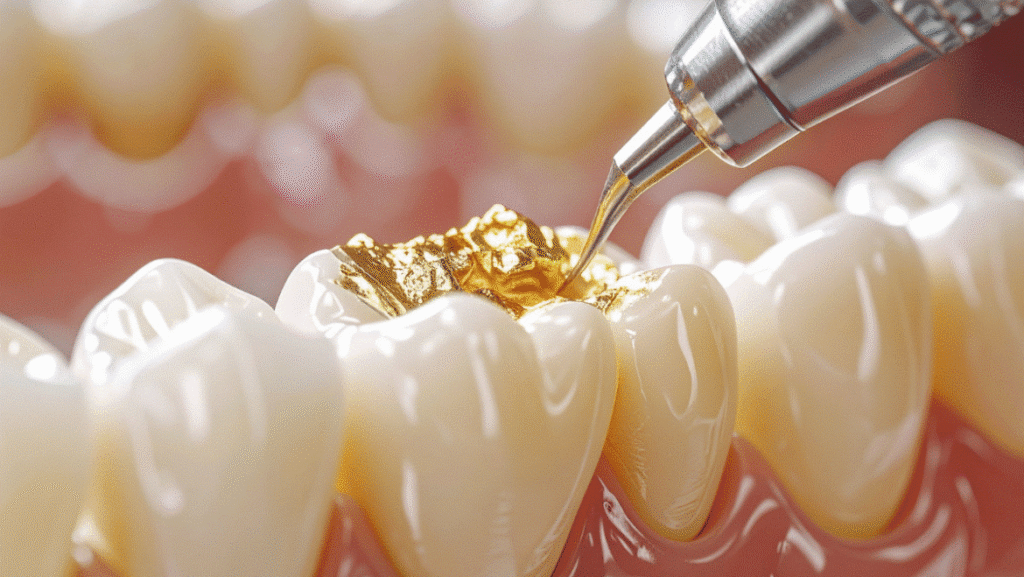
Gold inlays and onlays are among the most durable restorations in dentistry. A well-placed gold restoration can last 15 to 30 years or longer with proper care. They are fabricated in a dental laboratory from a gold alloy and cemented into place.
Gold restorations remain the gold standard in terms of clinical longevity, and some patients specifically request them for posterior teeth where aesthetics are not a concern.
Glass ionomer cement is a tooth-coloured material that bonds chemically to the tooth and releases fluoride over time, helping to prevent further decay in the surrounding enamel. It is less durable than composite resin and is generally used in lower-stress areas.
Glass ionomer is commonly used in paediatric dentistry, for root surface cavities in adults, and as a liner or base beneath other restorations.
Resin ionomer is a hybrid material combining properties of glass ionomer and composite resin. It retains the fluoride-releasing property of glass ionomer while offering improved aesthetics and slightly better durability. It sits between glass ionomer and composite resin in terms of strength and is used in similar clinical situations where fluoride release is beneficial but a better aesthetic result is also needed.
The filling for any individual patient depends on several clinical and personal factors. Your dentist will consider:
| Factor | How It Influences the Choice |
|---|---|
|
Location of the cavity |
Front teeth prioritise aesthetics; back teeth require durability |
|
Size of the cavity |
Larger cavities may require inlays, onlays, or crowns rather than direct fillings |
|
Bite pressure |
Patients with bruxism or heavy bites need highly durable materials |
|
Aesthetic preference |
Tooth-coloured options for visible areas |
|
Patient age |
Children’s teeth may benefit from glass ionomer’s fluoride release |
|
Allergies or sensitivities |
Metal allergies make ceramic or composite the appropriate choice |
|
Budget |
Costs vary significantly between material types |
The dentists in Abu Dhabi do not recommend a single filling material for every patient. They assess each cavity individually and present options with clear explanations of the trade-offs. That is the standard of care at Al Bahri Dental.
For most direct fillings (composite, amalgam, glass ionomer), the procedure is completed in a single appointment:
Indirect restorations (ceramic inlays, gold inlays) require two appointments: one to prepare the tooth and take impressions, and a second to fit and cement the final restoration.
Post-procedure sensitivity is normal and typically resolves within a few days to two weeks. If sensitivity persists beyond this, contact your dentist.
Filling longevity depends on material, size, location, and oral hygiene habits:
| Material | Average Lifespan |
|---|---|
|
Amalgam |
10 to 15 years |
|
Composite resin |
5 to 10 years |
|
Ceramic (porcelain) |
10 to 15 years |
|
Gold |
15 to 30 years |
|
Glass ionomer |
3 to 5 years |
Regular dental check-ups allow your dentist to monitor fillings for wear, cracking, or secondary decay developing at the margins. Catching a failing filling early prevents more extensive treatment later.
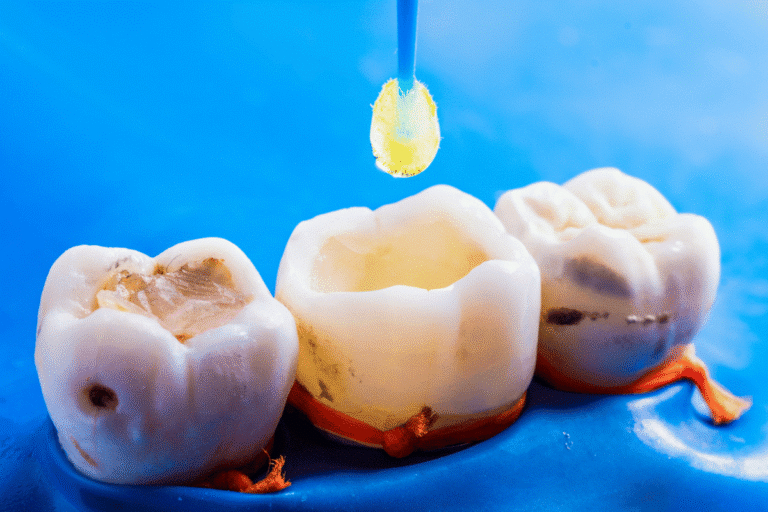
Fillings do not last forever. Signs that a filling may need replacing include:
Patients with old amalgam fillings sometimes ask whether they should replace them with tooth-coloured alternatives. The answer depends on the condition of the existing filling. If it is intact and functioning well, replacing it purely for aesthetics carries a small risk to the tooth. If it is showing wear or marginal breakdown, replacement with composite or ceramic is a sound clinical and aesthetic decision.
The dentists in Abu Dhabi will assess your existing restorations at every check-up and advise replacement only when it is clinically warranted.
Whether you have been told you need a filling, want to replace an old restoration, or simply want a thorough check-up and honest advice, Al Bahri Dental and Orthodontic Center is here to help.
As trusted dentists in Abu Dhabi, our team provides restorative, cosmetic, orthodontic, and preventive dental care across two conveniently located clinicsin Abu Dhabi and Al Ain.
Abu Dhabi: Khaleej Al Arabi Street, Building 836
Al Ain: Zayed Bin Sultan St, Town Center
Call us at +971 2 575 1856 (Abu Dhabi) or +971 3 764 3273 (Al Ain), or book an appointment online.
Your smile deserves the right care, from the right team.
The procedure itself is performed under local anaesthetic and should be painless. Mild sensitivity after the anaesthetic wears off is normal and typically resolves within a few days. Deep fillings close to the nerve may cause more prolonged sensitivity.
With composite resin fillings, you can eat as soon as the anaesthetic wears off, as the material is cured immediately during the procedure. With amalgam fillings, it is advisable to wait at least 24 hours before eating hard foods on the filled side to allow the material to fully harden.
A filling is appropriate when decay is confined to the enamel and dentine and has not reached the pulp. If the decay has extended to the pulp, a root canal is necessary before restoration. Symptoms such as spontaneous pain, prolonged sensitivity, or swelling suggest the decay may have reached the pulp and should be assessed promptly.
Modern composite resin has improved significantly in strength, and for small to medium cavities, it performs comparably to amalgam in most patients. For very large cavities or patients with heavy bite forces, ceramic or gold inlays offer superior durability. Your dentist will advise based on your specific clinical situation.
At every routine dental check-up, which should be at least once every six months. Regular X-rays allow your dentist to detect secondary decay beneath or around existing fillings before it becomes symptomatic.
As among the dentists in Abu Dhabi for restorative dentistry, our team takes time to explain every option, present the clinical rationale for each recommendation, and ensure patients feel confident in their treatment decisions. We offer the full range of filling materials and use digital imaging to support accurate diagnosis and treatment planning.
Why a Play Area Matters at the Pediatric Dentist Home / For most adults, a dental visit is a manageable inconvenience. For a young child,
Are There Different Types of Dental Fillings? A Complete Guide Home / If your dentist has told you that you need a filling, one of
Why Are Retainers So Important? Home / Introduction A root canal saves a tooth that would otherwise need to be removed. But the treatment itself